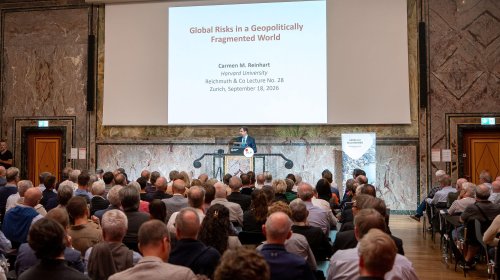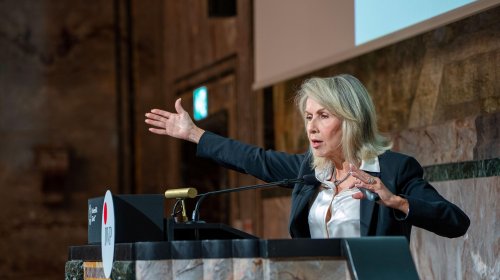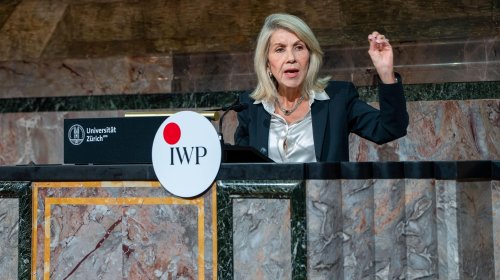
The global economy is at a turning point, declared Prof. Dr. Carmen Reinhart from the Harvard Kennedy School at the Reichmuth & Co Lecture No. 28 of the Institute for Swiss Economic Policy (IWP) at the University of Zurich. The national debt of many Western economies has reached levels previously known mainly from wartime. At the same time, demands on public budgets are rising due to defense, demographic change, and the energy transition. Precisely in this situation, geopolitical fragmentation and trade conflicts are questioning the international order that has made the debt accumulation of recent decades financially viable in the first place.
The former Chief Economist of the World Bank also warned of a potential AI bubble. The high valuations and strong investments in the AI sector are reminiscent of past speculative bubbles, such as the railway boom of the 19th century. No one can predict when such a bubble will burst. However, in conjunction with high debt and tightly interconnected financial markets, a collapse could have effects far beyond the AI sector. Thanks to its debt brake, Switzerland is comparatively well-positioned but remains dependent on a stable international financial system as a small open economy.
Furthermore, Reinhart focuses on other key questions of the global economy:
- Why the period between the 2008 financial crisis and the end of the pandemic was a historical exception in monetary policy.
- Why the dollar will remain the dominant anchor currency of the global economy.
- Why the independence of central banks is de facto more threatened than de jure.