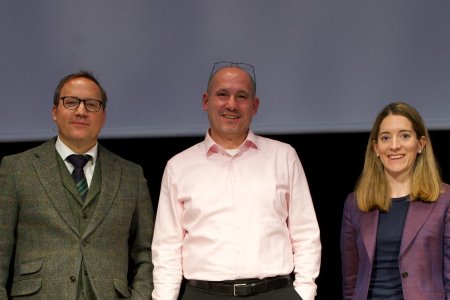
«We are richer and more equal today than any generation before us», says Prof. Dr. Daniel Waldenström from the Research Institute of Industrial Economics (IFN) in Stockholm in his lecture, which he delivered at the invitation of the IWP at the KKL Lucerne. The widespread notion that capitalism leads to an ever-increasing concentration of wealth does not hold up to the data. In the 20th century, the wealth of broad segments of the population grew significantly. Growth, democratization, and better education allowed workers to save for the first time, especially for their own homes and retirement. Today, residential real estate and pension assets make up about three-quarters of the wealth of private households in Western countries.
Waldenström also contradicts the widespread assumption that an inheritance tax reduces wealth inequality. It can even increase wealth disparities. Measured against one's own wealth, an inheritance weighs more heavily for heirs from the middle class than for very wealthy heirs, even if it is smaller in francs. At the same time, tax collection, lawyers, and tax avoidance cost an estimated 0.2 percent of GDP, which is about as much as the tax typically brings in. Therefore, those who want to tax capital should tax capital income, as this generates revenue without stifling entrepreneurship. Inheritance taxes are also not very effective as a means of increasing equal opportunities, as heirs are on average 55 years old. Therefore, schools are the key to equal opportunities.
Prof. Dr. Stefan C. Wolter, Director of the Swiss Coordination Centre for Research in Education (SKBF) and Professor at the University of Bern, subsequently explained which factors are crucial for a successful education policy. In his lecture on the Swiss education system, he emphasized the importance of vocational training: «Here you learn theoretically in the morning what you can apply practically in the afternoon». Vocational education raises prosperity from the bottom because it prevents dropouts and places young people with their talents in the right workplace. The combination of theory and practice motivates especially those young people who have no desire for more school years at 15. Cantons with a high proportion of apprentices among young people with compulsory schooling come closer to the goal of having 95 percent of 25-year-olds with a qualification beyond compulsory schooling.
If too many parents send their children to grammar school, vocational education lacks talent. The path through grammar school leads to the goal less often than many believe: ten to twelve years later, only about three and a half out of ten grammar school students have a master's degree and a job requiring a degree. Practical skills count in the job market. Those who do well in the practical part of the apprenticeship exam earn more than graduates with a lower grade, are more likely to be retained by the company, and are less often unemployed. Moreover, tens of thousands of companies are currently looking for successors every year. This opens the path to self-employment for well-trained professionals like never before.
Why entrepreneurship and broad prosperity are not opposites and why the Swiss education system should focus more on practice can be seen in the videos.
Other topics of the lectures:
- What Spotify, Microsoft, and Walmart show about the success of individual entrepreneurs not coming at the expense of others.
- Why inheritance taxes bring in little and contribute hardly to more equal opportunities.
- Why apprentices in Switzerland rarely strike, even though they earn little compared to international standards.